How to Know When Your Garage Door Spring Needs Replacing
Every spring breaks eventually. The question is whether you catch the warning signs early or wake up one morning with your car stuck inside the garage. In Kansas City, where summer heat and humidity stress metal components more than most people realize, torsion springs tend to fail faster than the national average. This checklist gives you the specific signs to look for, explains why KC weather matters, and walks you through what to do when it is time to replace.
What Does a Garage Door Spring Actually Do?
A torsion spring does one job: it counterbalances the weight of your door. Without it, your garage door opener would be pulling against a door that can weigh anywhere from 130 to 350 pounds depending on the material and insulation. The spring winds up as the door closes, then releases that stored energy to assist the lift when you open it.
Most residential torsion springs are rated for 10,000 to 15,000 cycles. One cycle equals one open and one close. A typical household runs the garage door three to five times a day, which means you can expect to replace springs every seven to twelve years under normal conditions. Kansas City conditions, however, are not always normal.
Why KC Summers Are Hard on Garage Door Springs
Heat and humidity are a two-punch combination that shortens spring life. Here is what actually happens to your spring during a Kansas City summer:
Metal expands in heat and contracts overnight when temperatures drop. That daily cycling stresses the coil structure at the micro level. Over time, small stress fractures develop near the winding cone, which is the most common failure point.
High humidity accelerates surface oxidation. Even oil-tempered springs can develop rust pits along the coils if they are not properly maintained. A rust pit is not just cosmetic. It is a structural weak point that reduces the spring's rated cycle count significantly.
Springs installed in garages without climate control face the worst conditions. Temperatures inside an uninsulated garage can reach 120 degrees Fahrenheit on a July afternoon in the KC Metro. That kind of sustained heat degrades the spring's temper, which is the hardness built into the metal during manufacturing.
This is exactly why we stock oil-tempered springs rated for Kansas City wind loads and temperature swings at our Gladstone location. Generic springs from a national chain are often spec'd for milder climates and simply do not hold up the same way here.
The KC Homeowner's Spring Inspection Checklist
You do not need any tools for this inspection. Stand inside your garage with the door closed and work through each item.
Visual check of the spring coils
Look at the spring mounted horizontally above your door on the metal bar (torsion bar). Run your eyes along the coils from one end to the other. What you are looking for:
Gaps between coils where there should be none. A healthy torsion spring has tight, evenly spaced coils when the door is closed. A visible gap, especially near the center of the spring, means it has already snapped or is close to snapping.
Rust or dark discoloration along the coils. Light surface rust is a warning. Heavy pitting or flaking rust means the spring's structural integrity is already compromised.
Coils that look stretched out or uneven. This indicates the spring is losing tension and no longer holding its rated load properly.
The door balance test
This is the single most reliable test for spring health. Disconnect your opener by pulling the red emergency cord. Then manually lift the door to about waist height and let go.
A properly balanced door stays put or moves no more than an inch in either direction. A door that crashes down or flies up has a spring that is either broken, severely worn, or incorrectly tensioned. Do not ignore this result. An imbalanced door puts serious strain on your opener motor and can shorten its life by years.
Listen during operation
Reconnect your opener and run the door up and down twice. Healthy springs are quiet. Warning sounds include:
A loud bang (often described as a gunshot sound) that already happened. This almost always means a spring snapped. Check the spring for a visible gap immediately.
A creaking or grinding sound during travel. This often means the spring is binding against the bearing plate or the coils are rubbing due to uneven wear.
A squealing sound that is new. Metal-on-metal contact from a dry or corroded spring.
Check the opener's effort
Watch your opener motor as the door travels. If it strains, slows down, or makes a laboring sound on the way up, the spring is no longer doing its share of the work. The opener is designed to move an already-counterbalanced door, not lift a full dead weight.
Measure the spring's diameter and length
If your spring is showing wear, you will want to know its specs before ordering a replacement. For a torsion spring, you need four measurements: wire diameter, inside diameter, length, and wind direction (left or right). If you are not sure how to identify these, send us a photo and we can spec the exact replacement for your door's weight and height.
Common Mistakes KC Homeowners Make Before Calling for Parts
Assuming one spring handles everything the same as two
Many garage doors have two torsion springs, one on each side of the center bracket. When one breaks, the remaining spring carries the full load. Homeowners sometimes run the door in this condition for weeks, not realizing the single working spring is now cycling at twice the stress load and will fail much sooner than normal. If one spring breaks, both should be replaced at the same time.
Using the wrong spring wire size
A spring that looks similar is not necessarily a match. Wire diameter changes of just a few thousandths of an inch significantly affect the spring's torque output. A spring with too little torque leaves your door heavy at the top of travel. Too much torque and the door slams open and puts stress on the stop bolts. Matching wire size to your door's exact weight is the only way to get the balance right.
Skipping lubrication until it is too late
Springs should be lubricated two to three times a year with a proper garage door lubricant, not WD-40. WD-40 is a solvent and will actually strip protective oils from the spring. A lightweight white lithium grease or a dedicated garage door spray works far better. In Kansas City's humid summers, a mid-season lubrication in July makes a real difference in how your springs handle the heat.
DIY Spring Replacement: What You Need to Know Before You Start
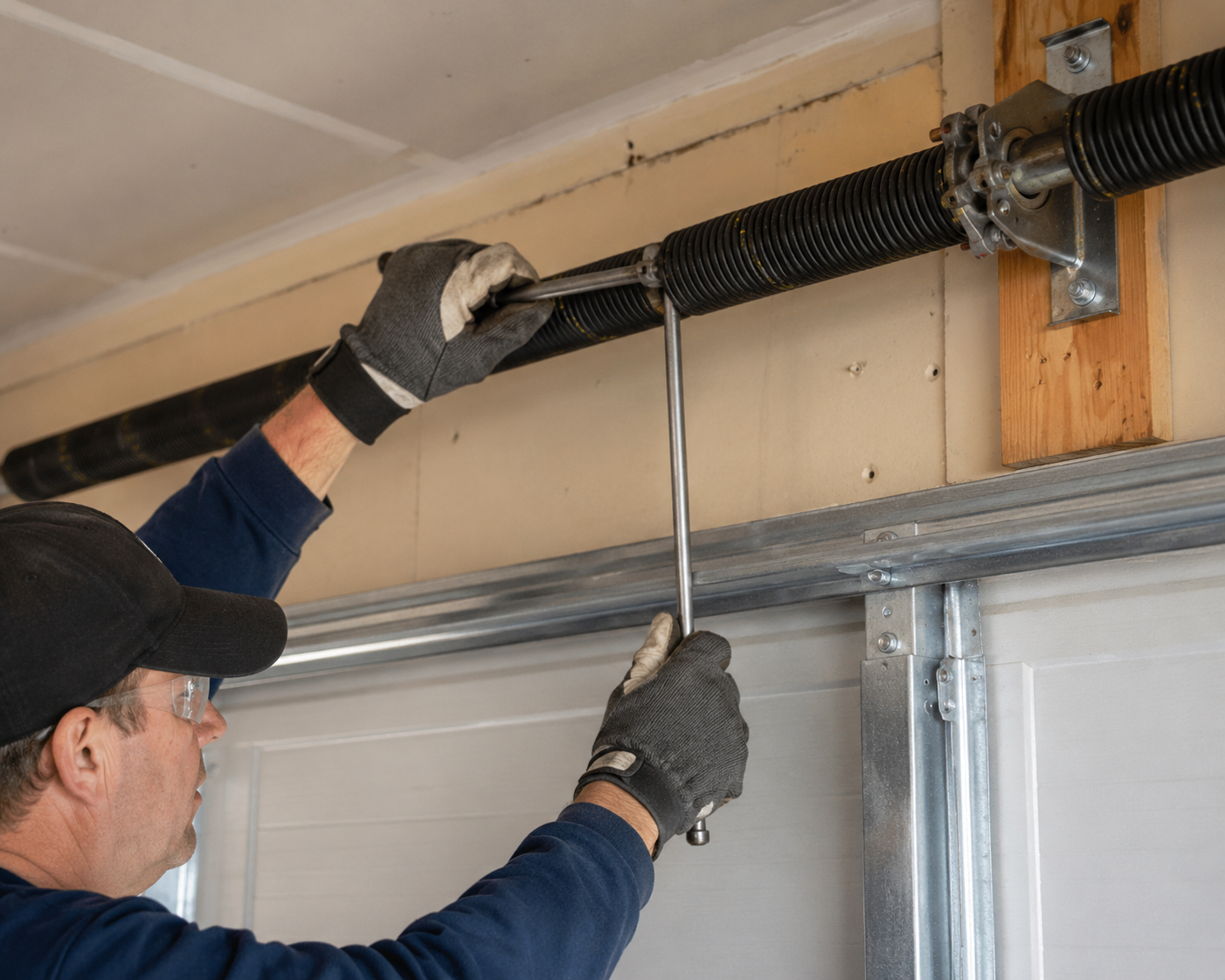
Spring replacement is a manageable DIY project when you have the right tools and follow safety rules carefully. Torsion springs store a significant amount of energy when wound. If one releases unexpectedly, it can cause serious injury.
We put together DIY Safety Rules, which we call "The Code," specifically for this reason:
Rule 1: Use the Right Tools. Never use a screwdriver or a rebar pin to wind a spring. We rent professional winding bars for exactly this purpose through our Tool Rental Program. Using improvised tools is the leading cause of spring-related injuries.
Rule 2: Respect the Tension. Always treat a spring as loaded and ready to move, even if you think it is fully unwound. Spring tension can remain even when a coil appears relaxed.
Rule 3: Clear the Area. Keep kids, pets, and anyone else out of the garage while you are working on springs or cables. The projectile risk from an unexpected release is real.
Rule 4: If You Are Stuck, Call Us. Getting halfway through a spring replacement and realizing you are in over your head is a common situation. Stop, leave the door in a safe position, and get in touch. Forcing a repair you are not comfortable finishing causes more damage than pausing does.
Our DIY Video Library also has step-by-step guidance to walk you through the process visually before you pick up a tool.
How to Order the Right Replacement Spring in Kansas City
You have a few options depending on how much information you have about your door:
If your spring is still intact and just showing wear, take the four measurements listed above (wire diameter, inside diameter, length, wind direction) and bring them in or send them through the contact form.
If your spring has already snapped, photograph the broken spring next to a tape measure for scale, and also photograph the door's manufacturer tag, which is usually located on the top section near the hinges. That tag gives us the door weight and height, which is what we actually need to calculate the correct spring torque.
We keep in-stock inventory at our Gladstone, MO location, which means you can often pick up the right spring the same day instead of waiting on a special order. For homeowners in Liberty, Kansas City, or the Independence and Blue Springs area, we are a short drive across the KC Metro.
Frequently Asked Questions
How do I know if my garage door spring is broken or just worn out?
A broken spring almost always leaves a visible gap in the coil, usually near the center. A worn spring may look intact but will fail the balance test: the door drops quickly when held at waist height and released. Both situations require replacement, but a broken spring means the door should not be operated at all until it is fixed.
Can I replace just one spring if only one broke?
Technically yes, but it is not recommended. When one spring on a two-spring system breaks, the other is usually near the end of its service life too since both have been cycling the same number of times. Replacing both at once saves labor and avoids a second breakdown within months.
Is it safe to open my garage door if the spring is broken?
No. Operating your door with a broken torsion spring puts the full weight of the door on the opener, which it is not built to handle. This can damage the opener motor, strip the drive, and in some cases cause the door to fall unexpectedly. Leave it closed until the spring is replaced.
What size spring does my garage door need?
Spring size depends on your door's weight, height, and the type of spring system already installed. The manufacturer tag on your top door section is the best starting point. If that tag is missing or illegible, a photo of the full door along with its height and width measurements is enough for us to calculate the right spec.
How long does a garage door spring last in Kansas City?
Standard residential springs rated for 10,000 cycles last roughly seven to ten years under normal Kansas City conditions. High-cycle springs rated for 25,000 to 50,000 cycles are available and are worth considering if you use your garage door frequently or want a longer replacement interval.
Wrapping Up
Catching spring wear early keeps your garage door running safely and saves you from a more stressful breakdown situation. Run through this checklist once before summer peaks, lubricate your springs if you have not already this year, and pay attention to any changes in how your door sounds or moves.
When it is time to replace, U-Install Garage Doors carries the KC-spec springs and rents the professional tools you need to do the job right the first time. Call us at (816) 745-1372 or
reach out online and we will help you get the exact parts your door needs.
Recent Posts